

Don’t Let Shame Stop You
“Confess your trespasses to one another, and pray for one another, that you may be healed.” - James 5:16
For twelve years, the woman in Mark 5 carried more than a physical condition.
Her situation affected her relationships, her community, and her religious life.
She could have allowed shame to convince her that she did not belong near Jesus.
Instead, she decided that she needed Jesus more than she needed people's approval.
Sometimes shame tells us to hide when God is calling us to come closer.
It tells us not to ask for prayer, not to admit we're struggling, and not to let anyone know we need help. But there is strength in saying, “I need prayer.” There is humility in admitting, “I’m struggling.” There is courage in saying, “Can you pray with me?”
You do not have to pretend that everything is okay when you come into God's presence. Jesus already knows what you are carrying, and He invites you to bring it to Him. Don't let shame, embarrassment, your past, or someone else's opinion keep you from reaching for Jesus.
Action Points:
Identify one burden you have been hiding and bring it honestly to Jesus.
Ask a trusted Christian to pray with you about it.
Prayer:
Jesus, help me stop hiding the places where I am hurting. Give me courage to bring my struggles into Your presence and to ask others for prayer when I need it. Remind me that I don't have to earn Your attention or pretend to have everything together. Help me run toward You instead of away from You. Amen.
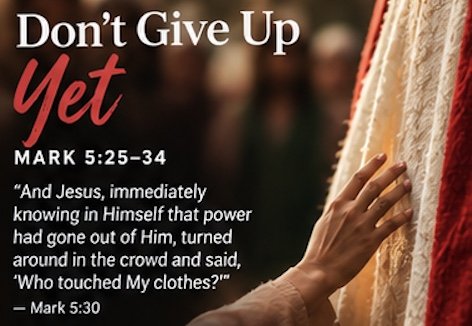
Don’t Give Up Yet
“When she heard about Jesus, she came behind Him in the crowd and touched His garment… For she said, ‘If only I may touch His clothes, I shall be made well.’” - Mark 5:27–28
The woman in Mark 5 had been suffering for twelve years. She had tried everything she knew to try, spent what she had, and yet her situation had gotten worse. But when she heard about Jesus, she made a decision: “I’m not giving up yet.”
Faith doesn’t mean we never experience disappointment. Faith means disappointment doesn’t get the final word. You can be tired and still believe.
You can cry and still believe. You can have questions and still believe. You can say, “I don’t understand what God is doing,” while still saying, “But I know who God is.”
Hebrews 10:23 reminds us to hold firmly to our hope because He who promised is faithful.
Your circumstances may not have changed yet, but God has not changed. So whatever you have been praying about, don’t let the length of the wait convince you to walk away from Jesus.
Action Points:
Keep praying about the thing you’ve been tempted to give up on.
Remind yourself today: “My disappointment does not cancel God’s faithfulness.”
Prayer:
Lord, help me keep believing when I am tired, disappointed, or discouraged. Give me strength to hold onto hope and trust You even when I cannot see the answer. Remind me that You are still faithful and that my waiting does not mean You have forgotten me. Help me keep moving toward You. In Jesus’ name, amen.
Trust God in the Waiting
“Wait on the LORD; Be of good courage, And He shall strengthen your heart; Wait, I say, on the LORD!” - Psalm 27:14
Waiting is one of the hardest places for our faith to live. We often want God to answer immediately, but God does not promise that every prayer will be answered according to our timetable.
The woman in Mark 5 waited twelve years. Twelve years is a long time to keep hoping.
Yet when she heard that Jesus was nearby, she still reached for Him. Sometimes faith has to survive the waiting room.
Waiting does not mean God is absent. Waiting does not mean God has forgotten you.
And waiting does not mean you have to stop trusting Him. There may be things happening that you cannot see or understand. God may be teaching you to trust His character even when you cannot see His plan. So while you wait, keep praying, keep worshiping, keep reading the Word, and keep believing.
Action Points:
Give God the situation you have been waiting on and consciously surrender the timeline.
When discouragement comes, say: “God is faithful, even while I wait.”
Prayer:
Father, waiting is difficult, but I choose to trust You. Strengthen my heart when I become discouraged and remind me that Your timing is not a sign that You have forgotten me. Help me trust Your wisdom when I cannot understand what You are doing. Teach me to wait with faith instead of fear. In Jesus’ name, amen.
Jesus Still Sees You
And He said to her, ‘Daughter, your faith has made you well. Go in peace, and be healed of your affliction.’ - Mark 5:34
For twelve years, this woman could have been known primarily by her condition.
People may have seen “the woman with the issue,” but Jesus saw something different. Jesus called her “Daughter.” Others may have seen her problem, but Jesus saw her faith. Others may have seen her weakness, but Jesus saw someone who kept reaching for Him.
What a beautiful reminder that Jesus sees more than the thing you are struggling with.
He sees your heart, your tears, your prayers, your faith, and every step you take toward Him. You may feel overlooked by people, but you are not overlooked by Jesus.
You may feel like your situation has defined you, but your struggle is not your identity.
Your faith does not have to be perfect for you to keep moving toward Jesus.
The woman simply kept reaching, and Jesus stopped for her. Whatever you are facing today, remember this: Jesus sees you, Jesus knows you, and Jesus cares about what you are carrying.
Action Points:
Spend a few minutes today thanking Jesus that He sees and knows you.
Replace one negative label you have placed on yourself with the truth of how Jesus sees you.
Prayer:
Jesus, thank You that You see me completely and still call me Yours. When I feel forgotten, remind me that You have not overlooked me. Help me stop defining myself by my failures, struggles, or circumstances and instead see myself through Your eyes. Give me faith to keep reaching for You. In Jesus’ name, amen.
WHAT IS GOD’S WILL FOR MY LIFE? - Give Thanks!
Scripture: 1 Thessalonians 5:18 — “Give thanks in all circumstances; for this is the will of God in Christ Jesus for you.”
Thanksgiving may be one of the most life-changing disciplines we can develop. We spend so much of life thinking about what we don't have that we can easily overlook what God has already given us. There is something powerful about deliberately stopping to recognize our blessings. The old hymn says, “Count your blessings, name them one by one,”and that simple practice can change our perspective.
We live in an age of constant marketing and social media where we are repeatedly shown what other people have that we don't. If we aren't careful, comparison can convince us that our lives are lacking when we are actually incredibly blessed. Scripture reminds us that God has “blessed us in Christ with every spiritual blessing in the heavenly places” (Ephesians 1:3). Gratitude shifts our attention from what is missing to what God has provided. It changes the questions we ask, the thoughts we dwell on, and even the decisions we make.
Giving thanks in all circumstances doesn't mean we thank God for everything that happens; it means that in every circumstance, we can find something for which to thank Him. Even in difficult seasons, we can thank Him for His presence, His grace, His faithfulness, His promises, and His love. Don't wait for Thanksgiving Day and turkey and dressing to start counting your blessings. Start today. The more we practice gratitude, the more we train our minds to recognize the goodness of God.
Action Steps
Make a list of 10 things you are thankful for today, and don't allow yourself to repeat the same things.
Whenever you catch yourself thinking, “I wish I had…”, replace it with, “Thank You, God, for…”
Prayer
Lord, forgive me for the times I've focused so much on what I don't have that I've forgotten how much You have already given me. Open my eyes to see Your blessings all around me. Teach me to be grateful in every circumstance and to recognize Your goodness even in difficult seasons. Help me count my blessings instead of counting what I'm missing. In Jesus’ name, amen.
WHAT IS GOD’S WILL FOR MY LIFE? - Pray Without Ceasing
Scripture: 1 Thessalonians 5:17 — “Pray without ceasing.”
I remember reading these words as a new Christian and thinking, “How is that even possible?” How could I possibly spend every second of every day on my knees praying? As I've grown in Christ, I've discovered that Paul wasn't telling us that we have to physically kneel and pray every moment of the day. He was describing a posture of the heart and mind.
Praying without ceasing means developing an awareness of God throughout our day. It means learning to bring our circumstances to God instead of carrying them alone and looking at life through the lens of faith and prayer. When something frustrates or worries us, we pray. We pray even when we receive good news. When we don't know what to do, we pray. Instead of allowing worry, anger, and frustration to consume our thoughts, we learn to turn those thoughts into conversations with God.
One evidence that we are drifting from prayer is when our minds become increasingly consumed by worry and frustration. Prayer doesn't mean we never have those thoughts; it means we learn where to take them. “God, help me. God, give me wisdom. God, change my heart. God, I trust You.” As we grow in Christ, prayer becomes less of an activity we schedule and more of an atmosphere in which we live. What once seemed impossible begins to feel natural. God's will is that we develop a heart and mind that continually turn toward Him.
Action Steps
Every time you catch yourself worrying today, turn that thought into a short prayer.
Before making decisions today, pause and simply ask, “Lord, what do You want me to do?”
Prayer
Father, create in me a mind and spirit that are always in a posture of prayer. Teach me to turn my worries into prayers, my frustrations into conversations with You, and my decisions into opportunities to seek Your wisdom. Help me become more aware of Your presence throughout my day. Thank You that I don't have to carry everything by myself. In Jesus’ name, amen.
What Is God’s Will For May Life - Rejoice Always
Scripture: 1 Thessalonians 5:16 — “Rejoice always.”
We often ask God, “What is Your will for my life?” We look for signs, direction, open doors, and answers about the future. But perhaps God’s will is sometimes simpler than we think: “Rejoice always.” God desires His children to live with a deep, abiding joy—not because everything is always good, but because we know that God is always good. The world’s happiness is often determined by circumstances, but Christian joy is rooted in our relationship with Jesus.
Our emotions are real, but they are also fleeting; we can feel discouraged today and encouraged tomorrow. Even when we don't feel happy, we can have an inner joy that reminds us that God is for us and not against us. We know that God is working behind the scenes, even when we cannot see what He is doing.
Romans 8:28 reminds us that God works all things together for good for those who love Him and are called according to His purpose. That doesn't mean everything that happens is good, but it means God can bring good even out of difficult circumstances. Psalm 30:5 says, “Weeping may endure for a night, but joy comes in the morning.” And Lamentations 3:22–23 reminds us that God's mercies are new every morning. The night may be difficult, but the night does not get the final word. We have a hope the world cannot give us and a joy the world cannot take away.
Action Steps
When something discourages you today, stop and remind yourself: “God is still good, God is still with me, and God is still working.”
Write down three things that bring you joy in Christ and thank God for each one.
Prayer
Lord, help me to rejoice always. When circumstances are difficult and my emotions are heavy, remind me that my joy is not dependent on what is happening around me. Help me remember that You are for me, You are with me, and You are working all things together for good. Give me the kind of joy that remains even in difficult seasons. In Jesus’ name, amen.
There May Be Silence, But Sunday is Coming!
52 This man went to Pilate and asked for the body of Jesus. 53 Then he took it down and wrapped it in a linen shroud and laid him in a tomb cut in stone,where no one had ever yet been laid. 54 It was the day of Preparation, and theSabbath was beginning.7 55 dThe women who had come with him from Galilee followed and saw the tomb and how his body was laid. 56 Then they returned and prepared spices and ointments.
On the Sabbath they rested according to the commandment. - Luke 23:52-56
The cross is behind them. Jesus is dead and his body is laid in a tomb. The crowds are gone and the noise has faded. And now there is silence. No miracles. No teaching. No movement but only confusion.
Everything the disciples believed seemed to fall apart in a single day. The One they trusted, followed, and gave everything for was gone. The promises they held onto didn’t look like they were coming to pass. This wasn’t what they expected. They thought Jesus would establish a kingdom and bring immediate victory. Instead, they were left with questions, grief, and what felt like defeat.
Have you ever been there? That place where God doesn’t seem to make sense. Where your prayers feel unanswered or what you believed would happen didn’t. The space between promise and fulfillment can feel like silence.
But what they didn’t know was that Saturday was not the end of the story. God was still working behind the silence and darkness. A plan was unfolding and victory was already in motion. Behind the sealed tomb, resurrection was coming.
Just because God feels quiet and you don’t see movement, doesn’t mean He is absent and nothing is happening. The disciples thought their faith had failed, but in reality, God was preparing His greatest miracle. And the same is true for us. There are moments when life doesn’t line up with what we expected God to do. But we can trust this:God is always working—for His glory and for our good.
Sunday is coming.
Think About This:
Where in my life does God feel silent right now?
Am I trusting God even when I don’t understand His plan?
Can I believe that He is still working behind the scenes?
Here’s a Prayer:
God, in the moments when I don’t understand and when You seem silent, help me to trust You. Strengthen my faith in the waiting. Remind me that Your plans are still unfolding, even when I can’t see them. Teach me to rest in Your goodness and believe that You are working all things for Your glory and my good. Amen.
The Cross Changes Everything
It was now about the sixth hour, and there was darkness over the whole land until the ninth hour, while the sun’s light failed. And the curtain of the temple was torn in two. Then Jesus, calling out with a loud voice, said,“Father, into your hands I commit my spirit!” And having said this rhebreathed his last. - Luke 23:44-46
Key Thought: The cross is not what we expected—but it is exactly what we needed.
No one expected this. The crowds who once shouted “Hosanna” now watched in silence. The disciples who believed Jesus would reign now saw Him hanging on a cross. To them, this looked like defeat.
A crucified Messiah didn’t fit their expectations. They thought salvation would come through power. Jesus revealed it would come through sacrifice. They thought He would overthrow Rome but Jesus came to overthrow sin. They thought He would take a throne but instead, He took a cross. And in that moment, what looked like loss was actually the greatest victory the world has ever known.
The cross wasn’t an accident nor a tragedy. It was the plan. Every nail, every wound, and every drop of blood carried purpose. Jesus wasn’t losing His life—He was giving it.
“For the Son of Man came… to give His life as a ransom for many.”
At the cross, we see the true meaning of Jesus’ mission:
Our sin paid for
Our guilt removed
Our debt canceled
Our relationship with God restored
This is what we needed—even if it’s not what we would have chosen. The cross confronts us and calls us beyond shallow belief. It invites us into full surrender. For if Jesus gave everything for us, how can we give Him anything less?
Think about the following:
Have I truly received what Jesus accomplished for me?
What area of my life do I still need to surrender in light of the cross?
Here’s a Prayer
Jesus, thank You for the cross. Thank You for taking my place, for carrying my sin, and for giving Your life for me. Help me to never take Your sacrifice lightly. Teach me to live in the power of what You’ve done and to surrender every part of my life to You. Amen.
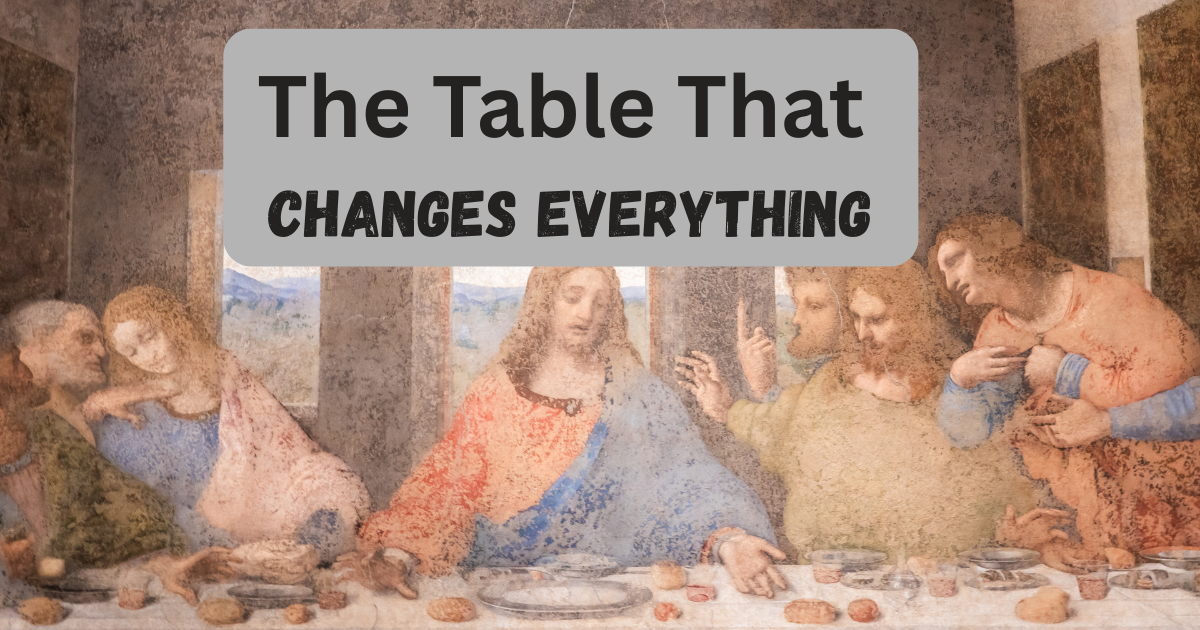
The Table That Changes Everything
And he took bread, and when he had given thanks, he broke it and gave it to them, saying, “This is my body, which is given for you. Do this in remembrance of me.” 20 And likewise the cup after they had eaten, saying, “This cup that is poured out for you is the new covenant in my blood. - Luke 22:19-20
The disciples gathered around the table with Jesus, expecting a celebration. Passover was a time of remembrance and victory—God delivering His people from Egypt. But this meal would be different. Instead of rallying them for revolution, Jesus broke bread and said, “This is my body given for you.” Instead of calling them to take up swords, He lifted the cup and said, “This is my blood… poured out for you.”
This wasn’t what they expected. They wanted a conquering King but Jesus revealed Himself as a suffering Savior. Even in that sacred moment, their expectations were misplaced. They were looking for power, position, and immediate victory—but Jesus was pointing to sacrifice, surrender, and eternal redemption.
The Lord’s Supper confronts us with the same tension. We often come to Jesus wanting Him to fix, provide, or change our situation. But at the table, He reminds us: He didn’t come just to improve our lives—He came to give His life.
The bread declares His body was broken and the cup declares His blood was poured out. This is not the table of our expectations but rather the table of His sacrifice and when we truly understand it, everything changes. We stop approaching Jesus casually and we stop following Him conditionally. We begin to receive Him fully—as Savior, as Lord, as King.
Ask yourself today…
When I come to Jesus, what am I expecting from Him?
Do I focus more on what He can do for me than what He has done for me?
Here’s a Prayer: Jesus, forgive me for the times I’ve approached You with my own expectations instead of reverence for Your sacrifice. Thank You for Your body broken and Your blood poured out for me. Help me to receive You fully—not just for what You give, but for who You are. Shape my heart through the cross. Amen.

The Crowd - Misplaced Expectations
The next day the large crowd that had come to the feast heard that Jesus was coming to Jerusalem. So they took branches of palm trees and went out to meet him, crying out, “Hosanna! Blessed is he who comes in the name of the Lord, even the King of Israel! - John 12:12-13
As Jesus entered Jerusalem, the crowd erupted with praise. They waved palm branches and shouted, “Hosanna!”—a cry that means “save us now.” They recognized Jesus as King, but their understanding of His kingship was limited.
They wanted a political savior, someone who would overthrow Rome, restore their comfort, and meet their immediate needs. They were celebrating Jesus—but for the wrong reasons. Just days later, many of these same voices would fall silent… or even turn away.
The truth is, it’s possible to praise Jesus and still misunderstand Him. We can follow Him for what He provides—peace, blessing, breakthrough, provision—while missing who He truly is: Savior, Lord, and King over every part of our lives. Jesus didn’t come just to fix circumstances. He came to redeem hearts. Real discipleship begins when we stop asking, “What can Jesus do for me?” and start surrendering to “Who is Jesus to me?”
Will we follow Him when He doesn’t meet our expectations? Will we trust Him when His ways look different than we hoped? The crowd welcomed Him with excitement. But only true followers stayed with Him through the cross.
Ask yourself:
Why am I following Jesus right now?
Would I still follow Him if He didn’t meet my current need?
Here’s a Prayer: Jesus, forgive me for the times I’ve followed You for what You can give rather than for who You are. Help me to see You clearly as Lord and King. Align my heart with Your will, not my expectations. Teach me to follow You faithfully—no matter the cost. Amen.
21 Days of Prayer and Fasting - Declaring His Deeds
One generation commends your works to another; they tell of your powerful acts. They speak of the glorious splendor of your majesty… They tell of the power of your awesome works—and I will proclaim your great deeds. - Psalm 145:4-6
Praise is never meant to stay private. Declaring what God has done multiplies faith across generations and geographies. When we testify of His mighty acts, we participate in His plan to make His glory known throughout the earth. This outward overflow deepens our own awe as we rehearse His faithfulness and inspires others to trust and worship Him. We were created not only to receive God’s deeds but to broadcast them, becoming living psalms in a watching world.
Imagine a grandfather gathering grandchildren around a fire, eyes shining as he recounts how God provided during famine, healed sickness, or rescued from danger. The children lean in, hearts stirred, and later tell their own children. Centuries later, those stories become Scripture or family legacy that still strengthens faith. One voice declaring God’s deeds creates a chain reaction of worship that outlives the teller.
Share one specific story of God’s faithfulness today—with a family member, friend, or on social media.
Fast from self-focus or silence about faith; intentionally declare His deeds.
Worship Song: Great Are You Lord (All Sons & Daughters) – https://www.youtube.com/watch?v=kvYQdJ6Ip9Q
21 Days of Prayer and Fasting - Praise Silences the Enemy
Through the praise of children and infants you have established a stronghold against your enemies, to silence the foe and the avenger. - Psalm 8:2
Devotional: Jesus quoted this psalm when children shouted “Hosanna” in the temple, infuriating the religious leaders. What seems weak—simple, childlike praise—God uses to build a fortress of strength that silences accusation, oppression, and every voice that rises against Him. The enemy thrives on our complexity, doubt, and sophistication, but pure, unfiltered praise from a trusting heart disarms him completely.
As we mature in worship, we are invited to recover childlike wonder: praising without agenda, without overthinking theology, simply because God is good. This kind of praise not only protects us personally but releases an overflow of God’s authority that stills every lying voice and advances His kingdom.
During Passion Week, children in the temple courts picked up palm branches and echoed the crowds: “Hosanna to the Son of David!” Their high-pitched voices rang through marble halls. The chief priests and teachers of the law were indignant—how dare children declare this carpenter from Nazareth as Messiah? They demanded Jesus stop them. Jesus replied, “Have you never read, ‘From the lips of children and infants you, Lord, have called forth your praise’?” In that moment, the simplest praise established a stronghold against religious pride and demonic opposition, paving the way for the triumph of the cross just days later.
Today, praise God like a child—loudly, simply, repeatedly declaring His goodness without worrying about sounding “mature.” Use short phrases like “Jesus, You are good!” or “Daddy God, I love You!”
Fast from cynicism, over-analysis, or sophistication in faith; embrace simple, joyful praise.
Worship Song: Graves Into Gardens (Elevation Worship) – https://www.youtube.com/watch?v=KwX1f2gYKZ4

21 Days of Prayer and Fasting - Praise and Healing
You turned my wailing into dancing; you removed my sackcloth and clothed me with joy, that my heart may sing your praises and not be silent. Lord my God, I will praise you - Psalm 30:11-12
David wrote this psalm for the dedication of the temple after God delivered him from deadly peril and deep grief. Praise is intricately linked to healing—emotional, physical, and spiritual. When we choose to praise in the midst of pain, we partner with God’s transforming power. He exchanges mourning for joy, not because circumstances instantly change, but because praise reorients our hearts toward His unchanging goodness. This overflow of healed praise becomes a testimony that brings healing to others, fulfilling our purpose to fill the earth with songs of His deliverance.
David had fled from Saul, lost friends, feigned madness, and lived in caves. Later, his own son Absalom rebelled. In the depths of betrayal and grief, David wore sackcloth and wailed. Yet God intervened, restored him, and turned his mourning into literal dancing. David’s response wasn’t temporary relief—it was a vow: “that my heart may sing your praises and not be silent… I will praise you forever.” His healed, overflowing praise became psalms we still sing today.
Bring a specific area of pain or brokenness to God today. Thank Him for past healing and praise Him for healing that is coming, allowing joy to rise.
Fast for personal or others’ healing (emotional, physical, relational); use hunger as a prompt to release praise.
Worship Song: Heal Our Land (Kari Jobe) – https://www.youtube.com/watch?v=5f9qS4lN2s0 (or a current healing-focused song)

21 Days of Prayer and Fasting - Praise in Trials
About midnight Paul and Silas were praying and singing hymns to God, and the other prisoners were listening to them. - Acts 16:25
After being severely flogged and thrown into the inner prison with feet in stocks, Paul and Silas chose praise at the darkest hour. Their worship wasn’t denial of pain—it was declaration of God’s greater reality. Midnight praise shook foundations, opened doors, broke chains, and led to the jailer’s household salvation. Praise in trials testifies that God is worthy regardless of circumstances, deepens our trust, and releases supernatural breakthrough that overflows to touch others.
Imagine the stench, pain, and darkness of a first-century Philippian prison. Bloodied backs against cold stone, legs locked—yet hymns rise. Other prisoners, expecting groans, hear songs of hope instead. Suddenly an earthquake targets only the prison: doors fly open, chains fall off. The jailer, assuming escape, draws his sword to take his life—until Paul shouts, “We’re all here!” That midnight praise not only freed Paul and Silas but saved an entire family and demonstrated Christ’s power to a watching world.
In your current trial, choose one song or Scripture of praise and sing/speak it aloud, even if emotions lag behind.
Fast from despair, self-pity, or complaining; replace with deliberate praise in hardship.
Worship Song: Firm Foundation (He Won’t) (Maverick City Music) – https://www.youtube.com/watch?v=flmFVmV5nVA
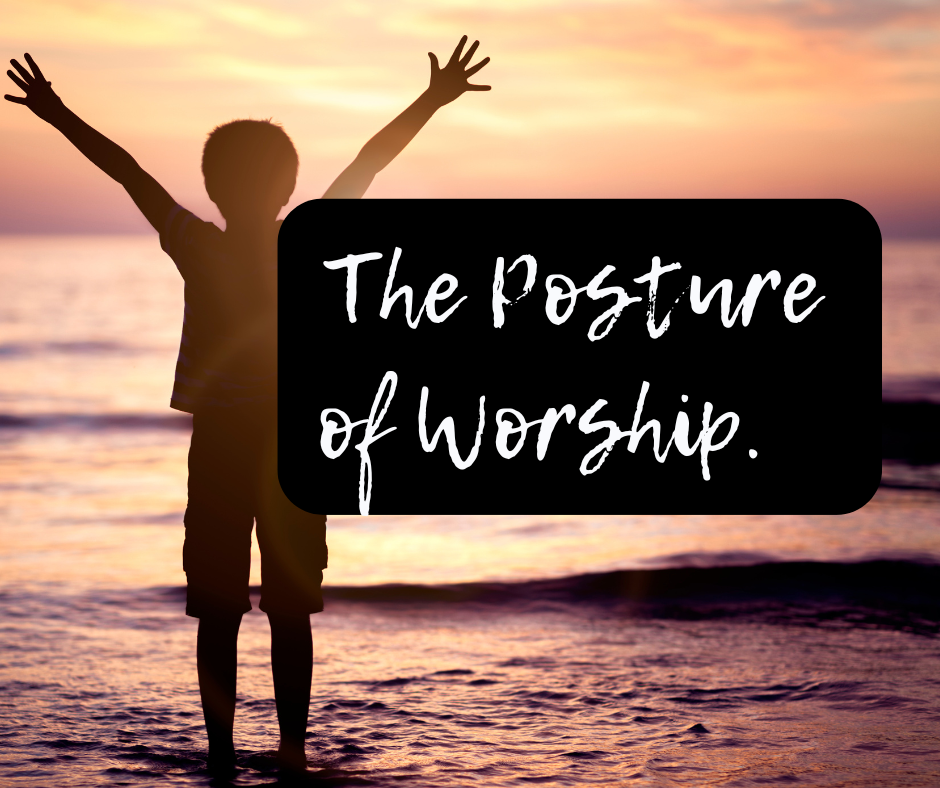
21 Days of Prayer and Fasting - The Posture of Worship
Come, let us bow down in worship, let us kneel before the Lord our Maker; for he is our God and we are the people of his pasture, the flock under his care. - Psalm 95:6-7
Worship engages our whole being—spirit, soul, and body. Scripture repeatedly calls us to physical postures: lifting hands (yadah), kneeling (barak), bowing, standing, dancing (halal), even lying prostrate. These aren’t rules but responses—our bodies aligning with our hearts to honor the God who formed us. Changing posture can break spiritual stagnation, express reverence, surrender, or joy, and invite deeper encounter. When we worship with our bodies, we declare that all of us belongs to Him, fulfilling our purpose as living testimonies of His glory.
In many cultures, bowing or kneeling before a king was mandatory protocol. Refusal meant rebellion. When Queen Esther approached King Xerxes uninvited, she risked death—yet he extended his scepter, and she found favor. How much more should we, sheep of the Good Shepherd, willingly bow before the King of kings who always extends grace? Every posture reminds us: He is Maker, we are made; He is Shepherd, we are tenderly cared for.
During prayer today, intentionally use different postures: stand in awe, lift hands in surrender, kneel in reverence, bow in humility.
Fast from physical comfort or distraction; let your body participate fully in worship.
Worship Song: Mighty Name of Jesus (Hope Darst, Live) – https://www.youtube.com/watch?v=CFfQFwjfTPY
21 Day of Prayer and Fasting - Enter His Gates with Thanksgiving
Enter his gates with thanksgiving and his courts with praise; give thanks to him and praise his name. - Psalm 100:4 (NIV)
Psalm 100 is a blueprint for approaching God. Gates represent access; courts represent intimacy. The key that unlocks both is thanksgiving. An ungrateful heart remains outside, but a thankful heart steps boldly into God’s presence where joy, provision, and transformation await. Thanksgiving acknowledges God’s past faithfulness, which builds faith for the present and future. When we cultivate gratitude, our praise becomes richer, our relationship deeper, and our lives a continual entrance into His glorious presence—an overflow that draws others to join us.
Picture the magnificent gates of ancient Jerusalem during a pilgrimage festival. Thousands streamed in, carrying sacrifices, singing psalms of ascent. The atmosphere was electric with gratitude for harvests, deliverances, and God’s covenant love. Those who grumbled about the long journey or the heat stayed emotionally outside the celebration, but those who chose thanksgiving stepped through the gates into courts filled with rejoicing, feasting, and encounter. Their gratitude wasn’t dependent on perfect circumstances—it was rooted in who God is: “For the Lord is good and his love endures forever.”
Before any request today, spend time entering His gates: list at least ten specific things you’re thankful for from the past year, then move into praise.
Fast from ingratitude or comparison; intentionally notice and voice God’s goodness.
Worship Song: Been So Good (Elevation Worship feat. Tiffany Hudson) – https://www.youtube.com/watch?v=D3yMC_qoAes
21 Days of Prayer and Fasting - Praise as a Weapon
After consulting the people, Jehoshaphat appointed men to sing to the Lord and to praise him for the splendor of his holiness as they went out at the head of the army, saying: ‘Give thanks to the Lord, for his love endures forever.’ As they began to sing and praise, the Lord set ambushes against the men of Ammon and Moab and Mount Seir who were invading Judah, and they were defeated. - 2 Chronicles 20:21-22 (NIV)
When three enemy armies marched against Judah, King Jehoshaphat’s first response was to seek the Lord and proclaim a fast. God answered: “The battle is not yours, but God’s.” Instead of sending elite warriors to the front line, Jehoshaphat sent worshipers singing of God’s enduring love. As their voices rose in united praise, the Lord caused the enemy armies to turn on each other until none remained. Praise became a divine weapon that released confusion in the enemy camp and victory for God’s people. This shows that praise shifts our gaze from the size of the problem to the greatness of our God, aligning heaven’s power with earth’s need and causing His glory to break through impossibilities.
Imagine standing on a ridge overlooking three vast armies advancing toward your small nation. Fear grips everyone—until the worship team steps forward, robed, unarmed, lifting voices in thanksgiving before a single arrow is shot. As the first notes of “Give thanks to the Lord, for his love endures forever” ring out, something supernatural happens miles away: alliances fracture, swords turn inward, and the enemy destroys itself. By the time Judah’s army arrives, they spend three days collecting plunder from a battlefield they never fought on—all because praise went ahead of them.
Identify a battle you’re facing (fear, addiction, broken relationship, financial pressure). Send praise ahead of it today—sing, declare Scripture, thank God for victory before you see it.
Fast from fear, anxiety, or rehearsing the problem; replace with deliberate praise as warfare.
Worship Song: Break Every Chain (Tasha Cobbs Leonard) https://www.youtube.com/watch?v=_pJDFRFN8VM
21 Days of Prayer & Fasting - Worship in Spirit and Truth
Yet a time is coming and has now come when the true worshipers will worship the Father in the spirit and in truth, for they are the kind of worshipers the Father seeks. God is spirit, and his worshipers must worship in the spirit and in truth.” - John 4:23-24 (NIV)
Jesus spoke these words to a Samaritan woman who was tangled in religion without relationship. He shifted the focus from location (this mountain or Jerusalem) to the heart. Worship “in spirit” means it flows from our regenerated spirit, led by the Holy Spirit, not mere ritual or emotion. Worship “in truth” means it is anchored in the revealed Word of God—knowing who He truly is and responding accordingly. Together, this creates authentic worship that the Father actively seeks. As we build on the Hebrew words of praise, we see they are expressions of spirit-and-truth worship: exuberant (halal), surrendered (yadah), faith-filled (towdah), and reverent (barak). True worship transforms us into the kind of worshipers God desires—intimate friends whose lives overflow with praise that fills the earth with His glory.
The Samaritan woman came to the well at noon to avoid people, carrying shame from five failed marriages and a current live-in relationship. Jesus met her there, revealed her story, and offered living water. When she realized He was the Messiah, she left her water jar—her reason for coming—and ran to the village shouting, “Come, see a man who told me everything I ever did!” Her testimony, born from a genuine encounter in spirit and truth, drew an entire town to Jesus. One broken life, transformed by authentic worship, became a conduit for the glory of God to overflow into a community that had been hostile to Jews for centuries.Application: Examine your worship today. Ask the Holy Spirit to reveal any areas that are routine without heart or emotion without truth. Confess and realign, then worship freely from your spirit, grounded in Scripture.
Fast from religious routine or superficial spirituality; seek a fresh, honest encounter with God.
Worship Song: Goodness of God (Bethel Music) – https://www.youtube.com/watch?v=-fv6o9sNashY

21 Days of Prayer and Fasting - Tehillah
Yet you are enthroned on the praises (tehillah) of Israel. - Psalm 22:3 (NIV)
Tehillah is the highest form of praise—a spontaneous, sung hymn or laudatory song that flows from a heart overwhelmed by God’s character and deeds. It is not rehearsed or scripted but birthed in the moment, often new melodies and words inspired by the Spirit. God literally “enthrones” Himself on tehillah, inhabiting these living songs and manifesting His presence powerfully. As we close the first week exploring the Hebrew words, tehillah ties them together: it can be exuberant (halal), surrendered (yadah), anticipatory (towdah), loud (shabach), reverent (barak), and musical (zamar). This spontaneous overflow invites God’s throne into our midst, transforming gatherings, personal times, and lives into dwelling places of His glory.
After God parted the Red Sea and drowned Pharaoh’s army, Moses led the men in a song of deliverance. Then Miriam the prophetess took a timbrel, and all the women followed with dancing and responsive singing: “Sing to the Lord, for he is highly exalted!” (Exodus 15:20-21). This was pure tehillah—fresh, Spirit-inspired lyrics and melody erupting on the shoreline, celebrating a miracle no one had seen before. Their spontaneous song marked the birth of a nation and became the first recorded worship chorus in Scripture.
In prayer today, ask the Holy Spirit for a new song. Sing whatever words or melody comes—even if simple or wordless—at least one fresh expression of praise.
Fast from planned, predictable routines in worship; open yourself to spontaneous, Spirit-led praise.
Worship Song: Holy Forever (CeCe Winans, Live from Madison Square Garden) – https://www.youtube.com/watch?v=VhdAZ2aQtBk